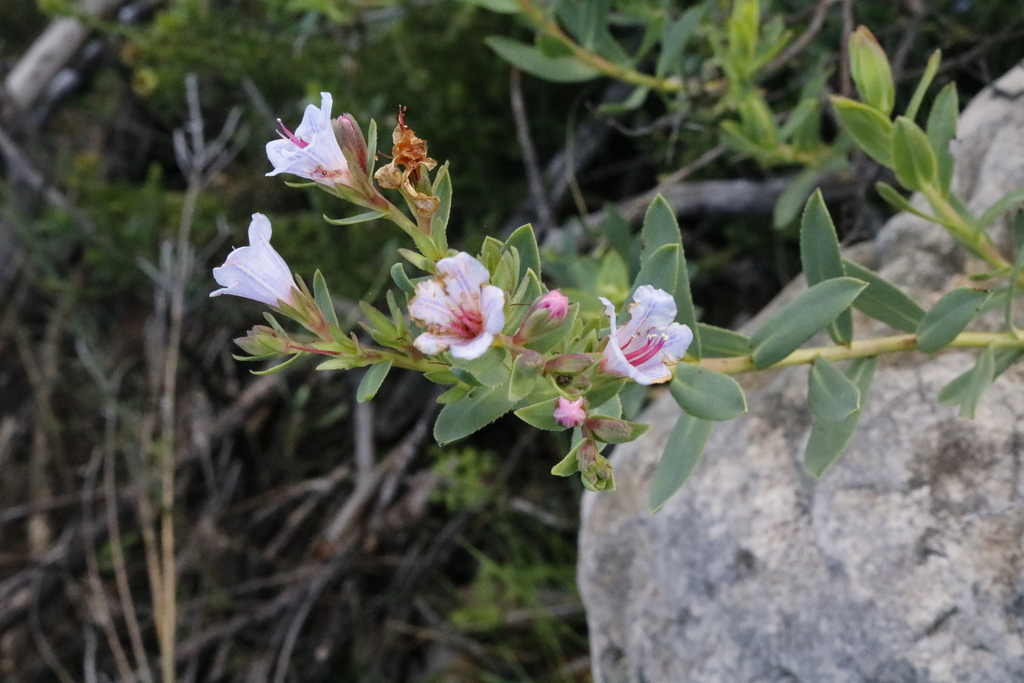
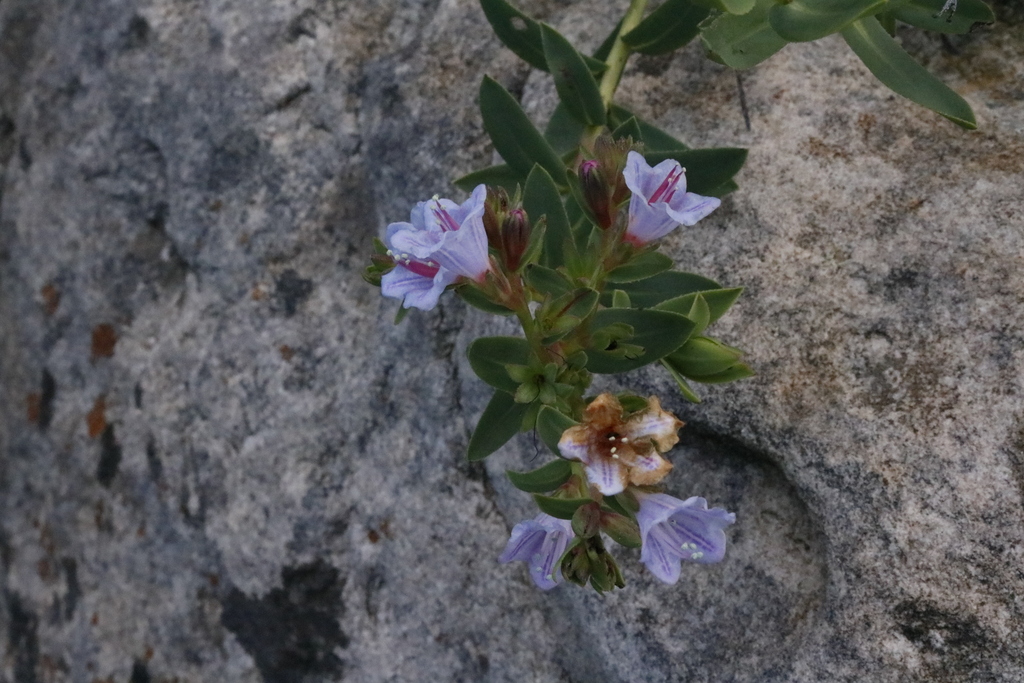
About: The Grey Healthbush (Lobostemon glaucophyllus) is a perennial shrub in the borage family (Boraginaceae). It is one of the well-known “gesondbos” plants of the Western Cape, valued for generations in traditional medicine. Its name reflects its healing reputation, and it is still used today in rural communities as a household remedy for a range of ailments.
Identification: This shrub grows to around 1–1.5 metres in height. It is characterised by its grey-green, felted leaves, which give the plant a silvery appearance. The leaves are narrow, lance-shaped, and covered in fine hairs. The flowers are tubular, pink to purple-blue, and appear in clusters mainly during spring, although flowering can extend into early summer.
Habitat: Grey Healthbush is native to the Western Cape of South Africa, where it grows in sandy soils, coastal flats, and lower mountain slopes. It is well adapted to the Mediterranean-type climate of the region, thriving in areas with wet winters and hot, dry summers. It is a hardy plant that often forms part of the fynbos vegetation.
Medicinal Uses: Traditionally, the Grey Healthbush has been used to treat chest and respiratory complaints such as colds, coughs, and bronchitis. Infusions made from the leaves were drunk to ease internal ailments, while fresh leaves were sometimes chewed for sore throats. For external use, crushed or boiled leaves were applied directly to wounds, sores, and ulcers to promote healing and reduce infection. In some traditions, it was also used for rheumatism and to ease inflammation.
History: The use of Grey Healthbush dates back to the indigenous Khoisan people of the Cape, who relied on it as part of their traditional medicine. Its healing reputation was later adopted by European settlers, who named it “gesondbos” (health bush) because of its many uses. Over the centuries, the plant has remained an important household remedy, especially in rural communities, and today it continues to be valued both for its cultural significance and its potential medicinal properties.