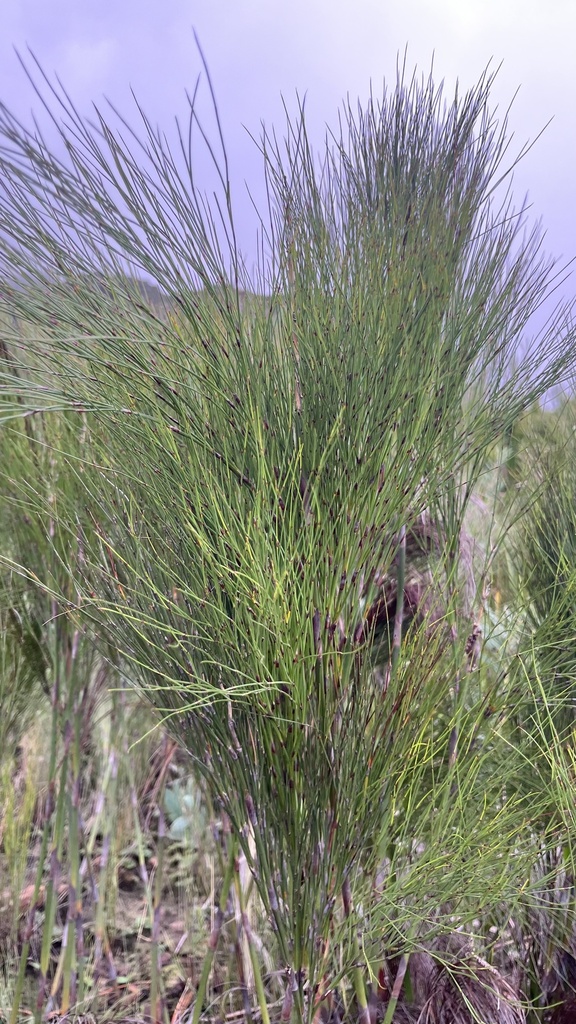
About: Branching Fountainreed (Cannomois virgata) is a perennial, tufted grass native to South Africa. It is characterized by its slender, reed-like stems and feathery flower heads, which give it a fountain-like appearance. This plant is commonly found in wetland areas, marshes, and along riverbanks, where it plays a significant role in stabilizing soil and preventing erosion.
Identification: Branching Fountainreed typically grows to a height of 1 to 2 meters. Its stems are slender, green, and cylindrical, resembling reeds. The plant produces feathery, panicle-like flower heads that are branched, giving it a distinctive fountain-like appearance. The leaves are narrow and linear, emerging from the base of the plant. The overall structure is upright and clump-forming.
Habitat: This species thrives in moist environments, particularly in wetlands, marshes, and along riverbanks. It prefers well-drained, sandy soils and is often found in areas with high water tables. Branching Fountainreed is native to the coastal regions of South Africa, including parts of the Western and Eastern Cape provinces.
Medicinal Uses: While Branching Fountainreed is not widely documented for medicinal use, some indigenous cultures have utilized various parts of the plant for traditional remedies. However, these uses are not extensively studied or verified in scientific literature. It's important to note that the medicinal properties of this plant are not well-established, and caution should be exercised when considering its use for health purposes.
History: Branching Fountainreed has been part of the indigenous flora of South Africa for centuries. While it has been used in traditional practices, its role in indigenous medicine is not extensively recorded. The plant's primary significance lies in its ecological contributions, such as soil stabilization and erosion control, rather than its medicinal applications.